Inheritance Lawyers in Italy
How inheritance works in Italy and how assets are distributed under local law. Our Italian inheritance lawyers can guide heirs through the procedure.

Persons interested in Inheritance Law in Italy should hire a specialist in the field. With the assistance of our Italian inheritance lawyers, one can understand how the assets are distributed within the family. Please review this article, then reach out to us for personalized assistance with this matter.
| Quick Facts | |
|---|---|
| Who can inherit family wealth? | Spouses, children, parents, and other relatives, depending on the family status and priority. |
What types of assets can be inherited? | – properties, – money, – government bonds, – businesses, etc. |
What is the “legittima”? | A forced share where some family members are automatically entitled to a part of the wealth of the deceased. |
| Fixed share in Italy | A fixed part of the estate is passed to the spouse, children, and ascendants. |
| What is forced heirship in Italy? | The legal succession is legally distributed to close family members, when Italian law governs the succession; under EU Regulation 650/2012 this is normally the law of the deceased’s last habitual residence, unless the deceased chose his or her national law. |
| What happens to the assets if there are no children? | On intestacy, the surviving spouse takes 2/3 of the estate if parents or siblings survive, otherwise the whole estate; the spouse’s forced share is 50%. |
| Distribution if there is one child in the family | Both the child and the spouse are entitled to a 50% share of the wealth. |
| Distribution in case of more surviving children | The spouse inherits 1/3 of the estate, while the rest of it is equally distributed to the children. |
| Assets distribution in case there are no spouses and children | The wealth passes by to the next line of succession, respectively the parents and other siblings. |
| Distribution of assets to children from a previous marriage (YES/NO) | YES |
| Mediation and arbitration for inheritance disputes offered (YES/NO) | YES |
| The importance of a will in Italy | For a proper distribution of assets in the family, according to the Inheritance Law in Italy. |
| Who gets the inheritance in case there is no will? | The priority degree is taken into account, and in this case, it is about close family members, respectively spouse, and children. |
| Inheritance tax in Italy | 4% imposed on assets worth more than EUR 1 million in the case of close family members |
| Why work with our Italian lawyers? | We can explain to you what the will entails, how the family distribution is done, and what happens from a legal point of view if there is no will. |
| Finding if there is a will left | Our Italian lawyers can inquire with the General Register of Wills (Registro Generale dei Testamenti, Ministry of Justice). |
Property disputes | In case foreigners demand their rights (for instance children from a previous marriage), although the estate inheritance for them is not mentioned in a will. Specific documents must be provided. |
Who is responsible for inheritance tax in Italy? | The heirs accepting the inherited estate |
| Can an heir renounce the right of inheritance? | Yes, typically when the deceased’s debts exceed the value of the estate. |
| What is alternative dispute resolution? | Mediation and arbitration for family inheritance cases. A neutral private judge can be implicated. |
| Can forced heirs challenge a will in an Italian court of law? | Yes, the action is called “azione di riduzione”. |
| Is a will an obligation in Italy? | No, but it is highly recommended. |
| Can an Italian lawyer help me make a will? (YES/NO) | YES |
| Holographic will | Accepted by the Italian Civil Code. This is normally presented at the notary for publication when a person is deceased. |
| Is international will accepted in Italy? (YES/NO) | YES |
| Revocation of will dispositions | Always possible (Civil Code arts. 679-680): by a new will or by a notarial deed expressly revoking the previous one. |
| Types of notarial wills | Secret or public |
| Witnesses required when signing a will (YES/NO) | YES for public and secret notarial wills (two witnesses); NO for a holographic will |
| Assisting heirs in the first instance | Yes, we assist in the first instance and also explain the legal rights. |
| Support for property transfer tax | On request |
How is inheritance done in Italy?
Forced heirship, even if a will is left behind.
What is the law applicable to inheritance in Italy?
The Italian Civil Code.
Can foreigners inherit assets in Italy?
Yes, they enjoy the same rights as Italians as long as the assets in question are in Italy. International private laws also apply in certain cases.
Who inherits the assets in Italy after a death?
- Spouse,
- Children,
- Parents,
- Other relatives, considering the family circumstances.
IMPORTANT: According to Italian law, if there are no successors/beneficiaries, the estate passes to the state.
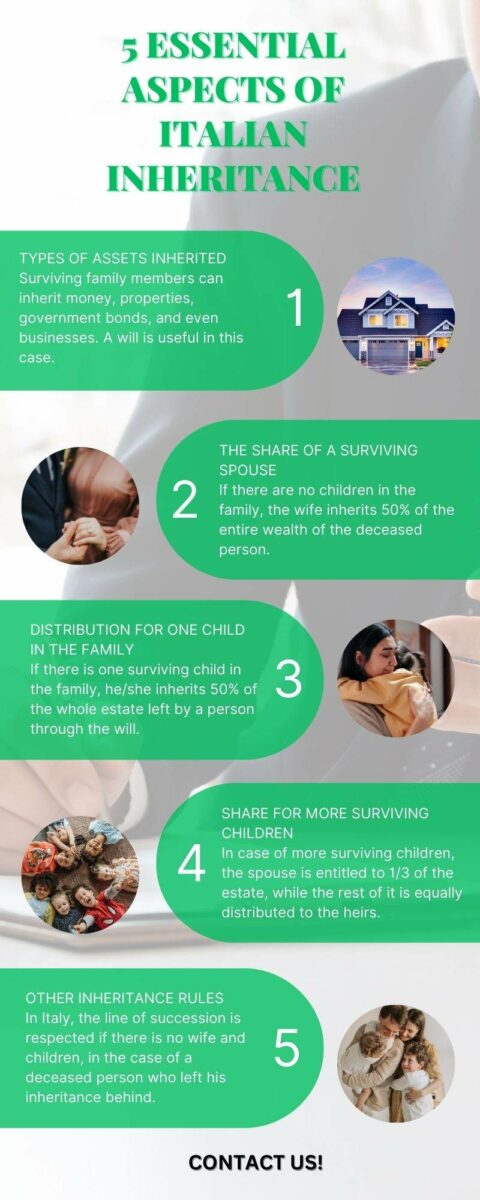
Please review the following infographic with information on this subject
What types of assets can be inherited in Italy?
- Real estate,
- Money/bank accounts,
- Business interests & shares,
- Intellectual property,
- Investments,
- Vehicles,
- Valuable collections, etc.
What is the reserved share in Italy?
The reserved share is the same thing as forced heirship and guarantees that a specific portion of the estate goes to the close family members.
Does Italy recognize foreign testaments?
Yes, if they comply with Italian and international laws. In this case, notarization and apostille are required before presenting the will in question to the authorities in Italy.
Do beneficiaries need to pay the debts left behind by the deceased?
Successors can:
- accept the inheritance, ask for an inventory, and limit the liability to the value of the received/inherited assets,
- renounce the inheritance to avoid liability for the debts.
We also invite you to watch a video about inheritance in Italy:

Do I need to register the inherited properties in Italy?
Yes, it is mandatory.
How is the asset distribution done in an inheritance process in Italy?
With one child, the spouse and the child each receive 50%; with two or more children, the spouse receives 1/3 and the children share 2/3.
What happens if there are no children to inherit the assets?
On intestacy, the surviving spouse takes 2/3 of the estate if parents or siblings survive, otherwise the whole estate; the spouse’s forced share is 50%.
How is the asset distribution if there are no surviving spouses and children?
The estate is passed on to the parents, grandparents, and other siblings.
Can children from previous marriages inherit assets?
Yes.
Can I get assistance in finding if a will is registered in Italy?
Yes, our Italian attorneys can perform specific verifications upon request from our customers.
What is the inheritance tax in Italy?
- direct family relatives – 4% tax rate for more than EUR 1 million/person,
- siblings – 6% tax rate for more than EUR 100,000 inherited per person,
- other types of relatives – 6% tax rate regardless of the inherited amount,
- other individuals (unrelated) – 8% tax rate on the entire inherited estate.
NOTES:
- inheritance tax is not waived, but if an heir qualifies for first-home benefits only fixed mortgage and cadastral taxes (EUR 200 each, instead of 2% + 1%) are charged on properties that are used as a primary residence or a first home.
- inherited government bonds and life insurance policies are not subject to inheritance tax in Italy.
Are there any inheritance-related precautions in Italy?
Yes, Foreigners living in Italy and receiving assets after a person’s death must present their Codice Fiscale to begin the inheritance process.
If you are ready to explore more about inheritance in Italy or simply need legal advice on asset distribution, feel free to contact our Italian law firm.
Francesco Dagnino, Attorney at Law · 1 October 2026