Family Lawyers in Italy
Family law in Italy: marriage, divorce, custody, parental responsibility, civil unions and alimony under the Civil Code. Contact our Italian family lawyers.

The Italian Civil Code governs Family Law in Italy and covers issues such as marriage, divorce, custody, parental responsibility, paternity, civil union, and alimony, among others. Our family lawyers in Italy can deal with Family Law issues in Italy and can provide you with legal advice and the necessary solutions. Both Italian and foreign citizens can call on our team of specialists regarding the problems encountered.
| Quick Facts | |
|---|---|
| Cases in which you can be represented by our family lawyers in Italy | – marriage, – divorce, – custody, – domestic violence, – paternity, – adoption, etc. |
| Legislation | Italian Civil Code |
| Divorce in Italy | Spouses can file for divorce after a period of legal separation of at least 6 months (consensual separation) or 12 months (judicial separation). |
| Types of divorces in Italy | – by mutual agreement (consensual) – contested (in a court of law) |
| Can foreigners get a divorce in Italy? | In most cases, yes, but it depends on residency, jurisdiction, and legislation in the country of origin. |
| How is child custody managed in Italy? | Spouses must act in the best interest of the minors, considering shared custody, alimony, education, visiting hours, etc. |
| Property regime after divorce | Common assets are equally divided between ex-spouses. |
| Is same-sex civil partnership recognized in Italy? | YES |
| What is a cohabitation agreement? | A document signed by unmarried partners who live together. This document describes how properties & finances are protected. |
| Timeframe to get a divorce decision in Italy | Between 24 and 36 months. |
| Marriage annulment | A nullity marriage decree is issued in the court of law. |
| Adoption requirements in Italy | Couples must have been married for at least 3 years (or have lived together stably for a total of 3 years including before marriage); since Constitutional Court judgment No. 33/2025 single persons may also apply for international adoption. |
| Establishing paternity in Italy | Mainly through DNA tests. |
| Representation in a domestic violence case | Immediately provided by our Italian lawyers. We can help in applying for a restraining order as a protective measure throughout the proceedings. |
| Working with our family lawyers in Italy | We offer legal advice and representation in a wide range of Family Law matters and act in the best interests of our customers. |
The Civil Code and the Family Law in Italy
In cross-border cases, the law applicable to family relationships is determined by Law No. 218/1995 (Private International Law Act) and EU regulations, which stipulates the conditions for getting married, the legal separation and dissolution of the marriage, filiation, legitimation and recognition of a child, the relationships between children and parents, etc.
A marriage is considered to be legal if it is concluded according to the law, in a civil ceremony. If the two spouses come from different countries, the relationship between them is regulated by the law in the country where they mainly live. The same law is applicable also for the properties of the two spouses, but they are allowed to decide if they will choose to respect the law from the country of residence or nationality of one of them. In order to choose a specific law for their property relations, the two spouses must sign an agreement. In case of separation or divorce, the applicable law is now determined by the Rome III Regulation (EU) No 1259/2010 (law chosen by the spouses; failing that, habitual residence, then common nationality, then the law of the court); previously Law No. 218/1995 applied the common law of the spouses or the law in the country where the spouses live or the Italian law. We invite you to discuss with our family attorneys in Italy and find out more about Family Law in Italy.
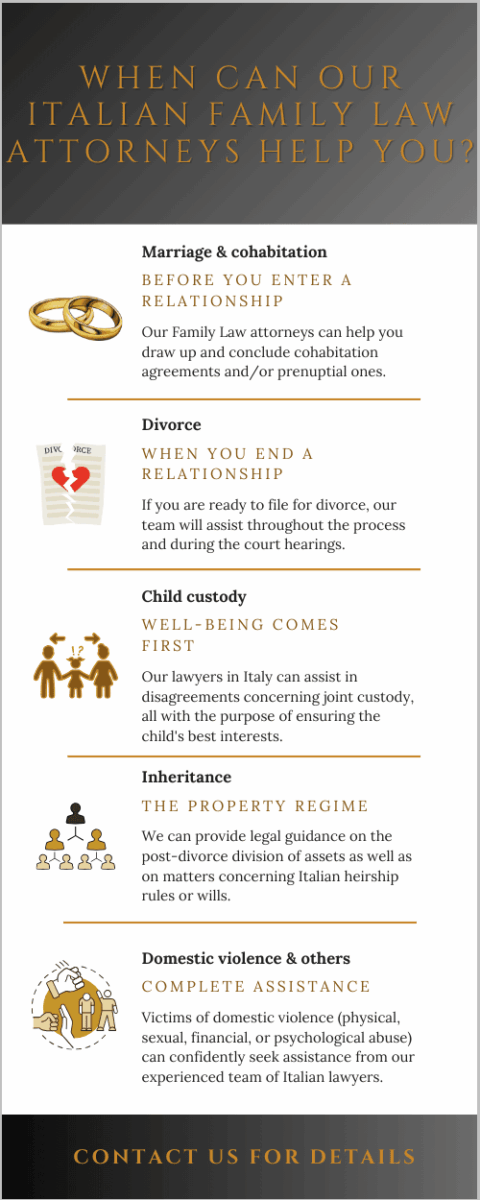
The infographic below summarizes the services offered by our specialized family lawyers:
Children issues in Italy
The status of a child (Italian law abolished the legitimate/natural distinction in 2012-2013) is governed by the child’s national law at birth or, if more favourable, by the law of the country where any of his parents is a citizen. The law applicable in this case is the one that is in force at the moment of the birth. For the acknowledgment of a child, the law is applicable for the parent in this case, if it is more favorable. The main provisions about family issues are to be found in the Italian Constitution that came into force in 1948. The Italian authorities protect the rights of the families and offer benefits for the large families. Even if a civil marriage is not recognized by the Italian church, it is fully valid; a Catholic (concordat) wedding, or one before a minister of another religion recognised by the State, also has civil effects once transcribed in the civil registers. Before they get married, the two spouses can choose, by notarial deed or at the wedding, the separation-of-property regime or another marriage settlement (convenzione matrimoniale); agreements made in contemplation of a future divorce are generally void under Italian case law. More details – from our family lawyers in Italy.
Getting married in Italy
Those who want to get married religiously in Italy can do so regardless of their religion. A Catholic (concordat) wedding, or one before a minister of a religion recognised by the State, has civil effects once transcribed, after the banns have been published at the town hall; no separate civil marriage is needed. The civil administrative procedure involves the preparation of documents, among which:
- the birth certificates of the two, in original and authenticated copies;
- identity documents;
- (no medical certificate or pre-marital health test is required under Italian law);
- a certificate stating that there are no legal obstacles to the civil ceremony taking place;
- the death or the divorce certificate if one of the persons has gone through these events;
- Atto Notorio signed by two witnesses when a couple gets married.
It is good to note that the Civil Registrar in Italy will deal with the verification and acceptance of documents. In the case of Catholic marriages, the couple must present certificates of baptism, proof of participation in a premarital course in Italy, a letter of no impediment to marriage in Italy, and the permission of the local bishop for marriage. Everything you need to know about Family Law in Italy and marriage can be found on our team of family lawyers in Italy.
Divorce in Italy
An Italian couple seeking a divorce can apply to the Italian courts or, by agreement, use assisted negotiation between lawyers or (with no minor or dependent children) a declaration before the civil registrar. If both partners agree to the separation, the divorce application is made after the partners have agreed to the custody of the minor children (where applicable), the division of assets, and alimony. Consensual separation and judicial separation are the two possibilities for obtaining the divorce of a couple in Italy. The divorce can be pronounced after a period of separation of 12 months (judicial separation) or 6 months (consensual separation). There are a few solid reasons for divorce that are mentioned by the law, such as incest, a conviction for one of the spouses, etc.
It is important to note that, if the divorce is by mutual agreement, the decision will be obtained after six months of continuous separation from the date on which the partners were present before the court in the legal separation process. There is also the situation where the divorce is based on a contested (judicial) separation, and in this case, the waiting period is one year. It is also essential here to specify that the judge in charge of the divorce process will be the one who will establish the custody of the children as well as the alimony paid by the parent who does not have the respective minor or minors.
We remind you that our family lawyers in Italy can take care of your case if you file for divorce.
Grounds of jurisdiction for divorce in Italy
The legislation is clear in this sense, namely that, EU Regulations enter into force to determine the legal grounds for a divorce in Italy or separation. Here is important information in this sense:
- Habitual residence is the primary argument to decide the jurisdiction. In this case, it is assumed that the spouses are usually residents in Italy or were last habitual residents.
- In the case of a joint application for divorce in Italy, either of the partners is habitually resident.
- The person who lived there for at least one year before filing for divorce or at least 6 months if the applicant is an Italian national is considered a habitual resident.
- On the other hand, the courts in Italy can also maintain jurisdiction if both partners are from Italy.
You can learn more about jurisdictions in cases of divorce in Italy from our family lawyers in Italy. Also, if you are interested in buying a property in Italy, do not hesitate to discuss further details with us.
What is an uncontested divorce in Italy?
Uncontested divorce in Italy can be acquired through two different paths:
- Private procedure – an agreement of divorce or separation can be reached before Italian lawyers and then authorised by the Public Prosecutor (no court hearing or court approval is needed) and then registered by the civil registrar.
- Judicial procedure – It takes place before the Italian court, where former spouses need to attend a hearing. There is also the possibility to be represented with a power of attorney by one of our Italian family attorneys.
The matrimonial regime in Italy
There are two matrimonial regimes in Italy, and the following information can clarify this subject:
- The common assets of the former partners, accumulated in the type of marriage, are distributed equally. Exceptions in this case are donations and inheritance, as the case may be.
- The assets owned before the marriage remain for each spouse separately. These are not divided and there are no exceptions in this case.
In the case of a divorce in Italy, the distribution of common assets can be done when the two partners agree on the separation in the case, obviously, in the presence of Italian family lawyers. It is also important to specify that matrimonial assets can be divided and distributed following a separate proceeding, which one of our specialists can explain to you.
Child custody in Italy
According to the Family Law in Italy and European Regulations, custody of minors after a divorce is shared between both parents as a rule (affidamento condiviso, Law No. 54/2006); sole custody is ordered only if shared custody would be contrary to the child’s interest. However, children must have family relationships with both parents, responsible for their good upbringing and education. In complicated divorce cases, the judge will establish custody of the children, taking into account everything that is best for them financially and not only.
It is important to note that joint custody is offered by the court, after analyzing the divorce decision and the parents’ requests. You can find out more about custody from our family lawyers in Italy.
Child maintenance calculated in Italy
Child maintenance is analyzed and administered only in Italian courts. In this case, the following aspects will be taken into account:
- parents’ income;
- the needs of the child or minor children resulting from the marriage;
- standard of living offered by both parents, in different homes;
- the time parents can spend with minor children;
- education and permanent residence of the child or children under 18 years of age.
On the other hand, according to Family Law in Italy, the minors in question must be supported financially and not only, until they finish their studies, including university. They can also be supported until they find a job to support themselves financially. It is also important to specify that no capital or property orders can be issued to or for the payment of maintenance of a child. We strongly recommend the legal services offered by one of our family attorneys in Italy to better understand children’s rights in case of parental divorce.
Civil partnerships in Italy
According to the Family Law in Italy, civil partnership is allowed, i.e. two adults of the same sex (Italian or foreign) establishing a civil union in Italy under Law No. 76/2016. Civil partnerships between two Italian partners concluded outside Italy are also accepted if they have a residence in this country.
Marriage and divorce statistics in Italy
Foreign citizens who want to divorce or marry in Italy can do these things if they comply with the applicable legislation in this country. Italy does not recognize same-sex marriage, but agrees with the civil union, regardless of the partners’ country of origin. Here are some statistics about marriage and divorce in Italy:
- According to the latest data, Italy ranks 11th in terms of divorce rate in Europe.
- In 2024, Italy recorded 173,272 marriages (about 2.9 per 1,000 population) and 77,364 divorces.
- around 46.4 out of 100 marriages in Italy end in divorce.
Working with our family lawyers in Italy
Professionalism, trust, and transparency are the basis of a good collaboration between a lawyer and a client, regardless of the problems to be solved. So, if you need an experienced lawyer in Family Law in Italy, you can get in touch with our specialists. They can give you the best solutions to the problems you face.
If you want to know more details about Family Law in Italy or other regulations, you may contact our law firm in Italy. Our family lawyers in Italy can offer you representation in case of divorce or other cases related to family issues.
Francesco Dagnino, Attorney at Law · 1 October 2026