Company Liquidation in Italy
How a company in Italy can be liquidated: the main types of liquidation, steps and procedures. Our lawyers in Italy assist owners throughout the process.

Company liquidation in Italy is required when the business is no longer profitable and needs to pay its debts to its creditors. Our Italian lawyers can offer more information about each type of liquidation and help you with the legal procedures.
| Quick Facts | |
|---|---|
| Reasons for company liquidation in Italy | Business strategy matters, poor business conditions, operating at a loss, etc. |
| The company’s status during liquidation | It still exists, however only to satisfy the claims of its creditors. |
| Types of liquidation | Voluntary or compulsory |
| Liquidation effects | The company ceases to exist/is de-registered. |
| Voluntary company liquidation in Italy | Decided by the company’s shareholders |
| Voluntary liquidation steps | Call the shareholder’s meeting to decide the commencement of the liquidation, appoint the liquidator, follow through with the liquidation of the assets and the submission of the final report. |
| Compulsory company liquidation in Italy | Decided by a court |
| Common reasons for compulsory company liquidation | Insolvency – when the company can no longer regularly pay its debts (judicial liquidation opened by the court) |
| Liquidator use (Yes/No) | Yes |
| Liquidator appointment | By the shareholders’ meeting (or by the court if the shareholders fail to appoint one) |
| Steps undertaken by the liquidator | Oversees the sale of the assets and the payment of creditors |
| Liquidation in case of bankruptcy | Judicial liquidation under the Crisis and Insolvency Code (Legislative Decree 14/2019), which replaced the Bankruptcy Law on 15 July 2022 |
| Satisfying the creditor’s claims | Creditors have an equal right to the payment of their claim. Certain creditors may claim priority. |
| Company de-registration following liquidation | In both types of liquidation |
| Estimated company liquidation duration in Italy | Can last one year or more. |
When can you wind up a company in Italy
Under the Italian Civil Code, a company can be liquidated under specific terms. Business owners can close a company in Italy when:
- the company was established for a limited period of time,
- the company’s capital was reduced below the minimum required by the Civil Code,
- the company cannot function anymore due to significant losses.
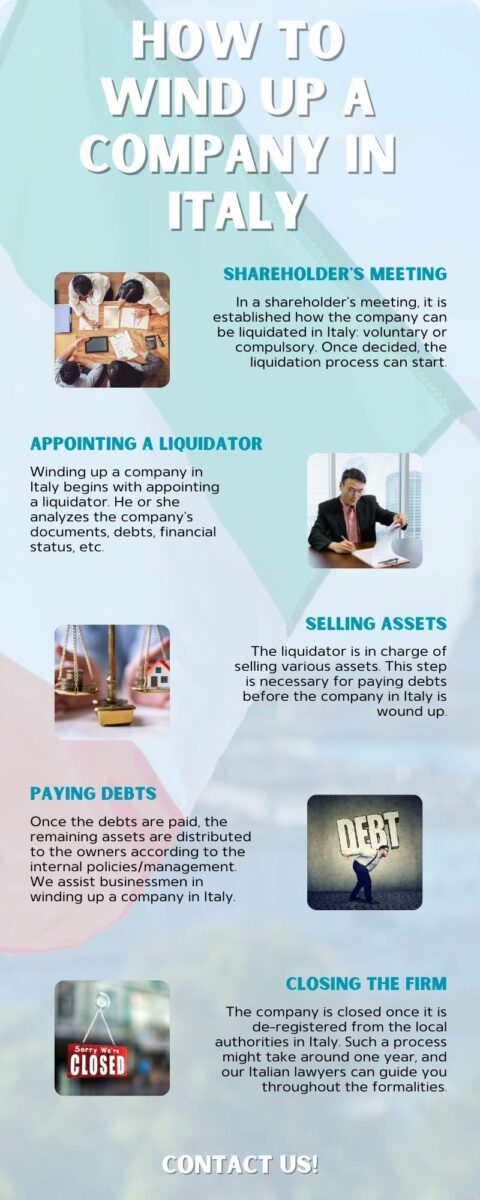
The winding up of a company in Italy is essentially its closure, which takes place after the liquidation phase, during which the claims are settled. Discover this infographic with details on this topic:
Voluntary company liquidation in Italy
Italian companies may be voluntarily wound up under the provisions of the Civil Code (Articles 2484-2496). The first step to voluntary striking off is to file the dissolution resolution with the Register of Companies (Registro delle Imprese), which places the company “in liquidation” from the date of registration in order to make sure all the creditors are paid. The Italian company’s directors must follow the next steps for company liquidation:
- to call a shareholders’ meeting,
- a public notary must attend the shareholders’ meeting,
- to decide on the company’s liquidation,
- to appoint a liquidator.
The shareholders will decide how the liquidation procedure will be carried out with respect to management throughout the winding up period and payment of the creditors. During the winding-up period, the liquidator will be in charge of all the business undertakings of the Italian company.
In order to avoid any issues or irregularities, it is advisable to find out more about the steps of voluntary liquidation from our Italian law firm.
Involuntary company liquidation in Italy
Another possible situation that can lead to winding up a company in Italy is involuntary liquidation. This can take place in the other aforementioned situations that do not concern significant losses that make it impossible for the company to continue its activities.
Our attorneys in Italy briefly summarize the situations in which the company can be subjected to involuntary liquidation:
- it was incorporated for a certain term, and it has reached its expiration date;
- if it was incorporated for a single corporate purpose and this purpose was reached, or it is determined that reaching the said purpose is impossible;
- when the company’s shareholders cannot reach any more agreements, and the company’s existence has come to a standstill;
- when the capital is reduced below the statutory minimum and it is not increased, or it is impossible to increase it again;
- when all the company’s shares have been redeemed.
Involuntary company liquidation in Italy can also take place in other cases if its Articles of Association specifically state this. Please discover the following video with details about the company liquidation process in Italy:

Compulsory liquidation in Italy
Compulsory winding up of a company can be requested by the debtor, its creditors, supervisory bodies or the public prosecutor. Compulsory liquidation usually happens when a company can no longer pay its debts and faces bankruptcy. Under compulsory liquidation the shareholders of the Italian company must file all the business’s financial records for the last three years, an assessment of the company’s activities, and a list of the creditors with the competent court (Tribunale).
The court opens judicial liquidation (liquidazione giudiziale, which replaced bankruptcy in July 2022) and appoints a trustee (curatore) to make an inventory and administer the corporate assets of the business.
Our Italian lawyers underline the fact that a prerequisite for bankruptcy is the company’s irreversible state of insolvency. This means that the company is no longer able to regularly meet its obligations (Article 2 of the Crisis and Insolvency Code).
While clear situations are often used to establish bankruptcy (such as the company’s repeated failure to pay its dues, or even shutting down the business premises), bankruptcy cannot be opened if the company’s overdue unpaid debts remain under less than EUR 30,000.
The following entities can file for bankruptcy in Italy:
- the company’s management body;
- a third party;
- a public prosecutor.
Our team can give you more details on how the process of filing for bankruptcy takes place in each of these cases. With our help, you will be able to determine if any of these is a route for winding up a company in Italy, in your case.
Both voluntary and compulsory company liquidation procedures end with the de-registration of the company with the Register of Companies (Registro delle Imprese).
Bankruptcy statistics in Italy
As seen in this article, winding up a company can involve complex steps and following specific procedures for this purpose. This is why we advise company owners whose businesses are in difficulty to reach out to our local lawyers.
According to data from the Chamber of Commerce, the number of judicial liquidations (formerly bankruptcies) in Italy has been rising:
- the number of companies forced to end their activity has increased;
- during the first six months of 2025, there were 5,286 companies that entered judicial liquidation (the procedure that replaced bankruptcy);
- in the whole of 2024 the number of judicial liquidations opened was 9,203;
- for comparison, in the whole of 2023 there were 7,685 judicial liquidations.
Apart from our services related to company creation or ceasing the activities of a company, we also assist those interested in buying a property in Italy. A series of steps is needed, and our lawyers in Italy can detail them. Our team has experience in real estate matters and especially in the problems that may arise in this sector. It will be necessary to verify the documents, namely the title deed, sale-purchase agreement, building permit, and cadastral documents. Note that buying property in Italy does not by itself give a right to residence or citizenship, a matter where all the legal aspects can be explained by our local specialists. Contact us as needed.
In addition to the assistance we provide to those who close a company in Italy, we can also offer you legal advice if youwant todivorce in Italy.
For more information on both company winding up methods, please contact our lawyers in Italy.
Francesco Dagnino, Attorney at Law · 1 October 2026